Dialogical Sequence Analysis
Dialogical Sequence Analysis (DSA) is a method of listening. It allows one to observe how a person positions themselves in speech in relation to the world, to others, and to themselves — without external instruments or interview frameworks.
Origins

Mikael Leiman
Dialogical Sequence Analysis took shape in the early 1990s. At that time I was working as a cognitive-analytic psychotherapy trainer. The method characteristically seeks to describe obstacles to client agency individually, already during initial sessions. It is a demanding task, requiring conceptual tools through which — simply by listening to the client's expression — one can form hypotheses about their characteristic ways of acting and relating.
Psychotherapy students kept asking how I listen to client expression and how I distinguish recurring patterns within it. Answering this question required articulating the concepts guiding my observation. It was not easy. Only in 2015 did I manage to crystallise the conceptual framework into a form that can be taught without forcing the student to traverse the conceptual-historical wilderness in which I myself had wandered for nearly a quarter century.
Theoretical Foundation
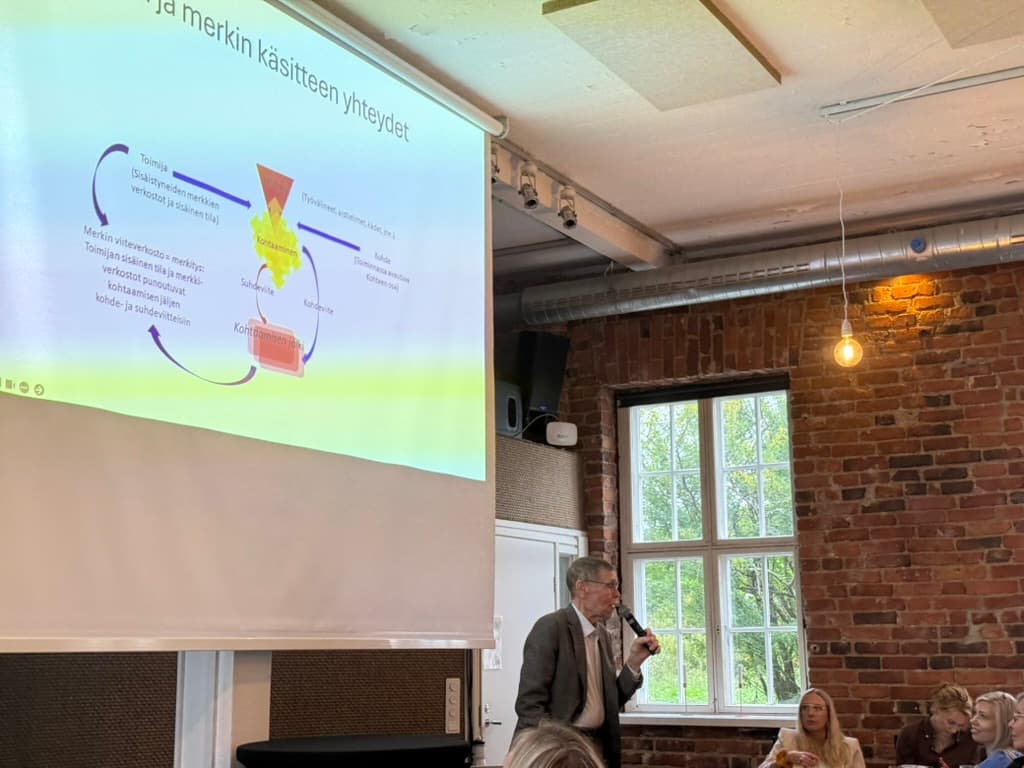
The conceptual tools of dialogical sequence analysis are grounded in Vygotsky's theory of sign-mediated activity and Mikhail Bakhtin's theory of expression. Expression is sign-mediated activity that, according to Bakhtin, always has two objects. One is the referent of expression — what the speaker is talking about. The other is the addressee — the person to whom the speaker directs their words. This is the fundamental structure of all expression. Speaker, addressee, and referent form a force field that regulates the content and progression of expression.
The core idea is that when describing a referent and expressing their attitude toward it, the speaker always takes into account who they are speaking to. They choose their topic and arrange their words according to how they expect the addressee to respond to what they have to say. The connection between addressee and referent is, from the speaker's perspective, reciprocal.
The addressee does indeed have their own relationship to the object and to the speaker. The speaker can learn about it if the addressee expresses their own attitude. In client work, however, the addressee — that is, the professional — must remain in their professional role. What they themselves think about the object is not what matters. Their task is to help the client clarify their own relationship to the object and the various consequences of that attitude.
Word as Expression of Attitude
The referent of expression — what is spoken about — always contains a unity of object and attitude. We cannot describe anything without simultaneously expressing our relationship to it. Word choices contain the most important clues about the speaker's orientation toward the referent of their speech. The content of words also helps us perceive how the object or web of objects appears to the speaker themselves and what they focus their attention on.
What is said and how it is said form the endlessly varying, temporally unfolding flow of verbal expression. From this stream we form hypotheses about the objects important to the speaker, how those objects appear to them, how they relate to them, and how we as addressees participate in shaping the expression of referents and attitudes.
We have countless ways of expressing both objects and our attitudes toward objects through words. We tend not to think about this, because we are inclined to treat word meanings as merely naming the object in one way or another. That very 'in one way or another' points to the speaker's attitude.
Take the word 'house'. It is a neutral way of referring. 'Shack', 'dump', and 'hovel' reveal the speaker's way of seeing the house as insignificant and wretched. If they call an ordinary home a palace or a fortress, the discrepancy between object and expression reflects an attitude involving irony, sarcasm, or perhaps envy. Because word choices can simultaneously express both the object and the relationship to it, they are always worth attending to when listening to a client.
Example: General Practitioner's Consultation
The following example of how word choices describe the relationship to the object and the addressee is from a general practitioner's consultation.
Patient: W:ell, (0.7) °mm: uh °uv:: last Thu:rsday I started catching ↑a little flu bug and .mmh ((sniffing inward)) (0.2) I thought it'd pass and .mh
Doctor: ↑Mm: [m,
Patient: [ >Th-then I started< getting a sore throat and now (there are) these kind of ↓so:res >or these< .hhmthh ↑bu:mps°. Hh
Doctor: ↑Yea ↓ah. ((Doctor moves chair toward patient.))
The turns are marked with conversation analysis notation: pitch shifts (↑), volume changes (°), sound stretching (:), tempo changes (><), pauses and overlapping speech ([).
Speech prosody is an essential clue to the speaker's attitude toward the referent, especially its emotional tone. The patient's first attitude toward the object is contained in the formulation 'catching a little flu bug'. It is a social cliché expressing a coping, symptom-minimising orientation. The patient's way of stretching 'Thursday' may reflect uncertainty about the timing. The minimising relationship to flu symptoms is repeated in the patient's assumption that it would pass.
Yet the patient directs the description to the doctor. Patients also justify their visit through symptom descriptions. An ordinary flu does not usually require a doctor's visit. By describing new symptoms, the patient justifies the visit. The word choices for the referent are now more dramatic. The standard 'sores' is supplemented by 'bumps'. A slight emphatic stretch in 'so:res' contains shades of uncertain worry. By using additional description, the patient expresses their uncertainty more clearly — they cannot assess what the symptom is.
When retrospectively interpreting the patient's attitude toward the referent and addressee, one must be cautious. Only in the course of living dialogue is it possible to find additional clues that emerge in the patient's way of responding to the doctor's turn or action.
Ruusuvuori, J. (2001). In Sorjonen, Peräkylä & Eskola (eds.): Keskustelu lääkärin vastaanotolla, p. 39.
Clinical Evidence
DiaSek® as an assessment method was developed from 2013 onwards. A randomised clinical trial at Päijät-Häme Central Hospital's psychiatry clinic (2015–2016, n=80) showed DiaSek® to be significantly more client-centred than conventional psychiatric assessment: patient-assessor agreement on treatment goals was 0.63 versus 0.26 in conventional assessment (Spearman's Rho).
Savander et al., European Journal of Mental Health
Dialogical Guidance
Dialogical guidance is a versatile, client-centred guidance intervention developed from cognitive-analytic therapy — a goal-oriented, brief psychotherapy method. It uses Dialogical Sequence Analysis (DSA) as the worker's tool: through DSA, the worker can listen to and identify conditions and obstacles to client agency from the very first meeting.
Like its predecessor, dialogical guidance relies on describing the prerequisites and obstacles to client agency. This description is formed together with the client during the first session and refined as guidance progresses — ensuring that the objectives are relevant and realistic from the client's perspective. Various working methods can be flexibly applied, and the duration varies depending on jointly set goals.
Dialogical guidance has been applied in three European Social Fund projects aimed at supporting the agency of young people and young adults at risk of marginalisation:
Path to the Labour Market (2004–2007)
A project in the Joensuu region targeting the hardest-to-employ 16–34-year-olds. The goal was to strengthen youth agency by developing the professional competence of guidance providers.
Read project publication →Youth Support (2009–2014)
Managed by the North Karelia Municipal Education and Training Consortium, offering low-threshold guidance and education services to 15–24-year-olds outside education and employment. Operating models included Ohjaamo and Open Vocational College.
Read project publication →Supporting Agency (2012–2014)
A University of Eastern Finland guidance education project developing guidance as a support for citizens' agency in education and work transitions. Dialogical guidance was the intervention taught in the training component.
Read project publication →The research base for DSA extends from individual case studies and theoretical development to randomised clinical trials. The efficacy study conducted at Päijät-Häme Central Hospital's psychiatry clinic (2015–2016) demonstrated that this is not merely a way of listening but a method with measurable impact on the client-centredness of care.
Key Papers
Leiman, M. (2012). Dialogical sequence analysis in studying psychotherapeutic discourse.
International Journal for Dialogical Science, 6(1), 123–147.
Comprehensive presentation of the DSA method and its theoretical foundations.
Valkonen, H. (2015). Dialoginen sekvenssianalyysi ilmaisujen tutkimisen mikroanalyyttisenä menetelmänä.
In Toimijuuden tuki: dialoginen ohjaus. University of Eastern Finland.
Overview of DSA, DiaSek® and dialogical guidance — foundations and research findings.
Leiman, M. (2011). Mikhail Bakhtin's contribution to psychotherapy research.
Culture & Psychology, 17, 441–461.
Application of Bakhtin's theory of expression to psychotherapy research.
Kivikkokangas, S., Leiman, M. & Enckell, H. (2025). The development of self-observation as a precondition for self-analysis.
Scandinavian Psychoanalytic Review.
Case study of self-observation development analysed through DSA.
Savander, E. et al. (2019). Implementation of dialogical sequence analysis as a case formulation for the assessment of patients at a community mental health centre.
Randomized controlled pilot study.
Randomised clinical trial of DiaSek® assessment.
Kivikkokangas, S. & Leiman, M. (forthcoming). Dialoginen sekvenssianalyysi — kliinisen kuuntelemisen menetelmä.
Vastapaino.
The first DSA handbook in Finnish.